NAD+ and Coenzyme Q10 : Why These Two Molecules Are Complementary in Mitochondrial Biology
Longevity Science
8 min
Cell Metabolism · Nature Reviews MCB · Journal of Clinical Investigation · EPFL · PubMed
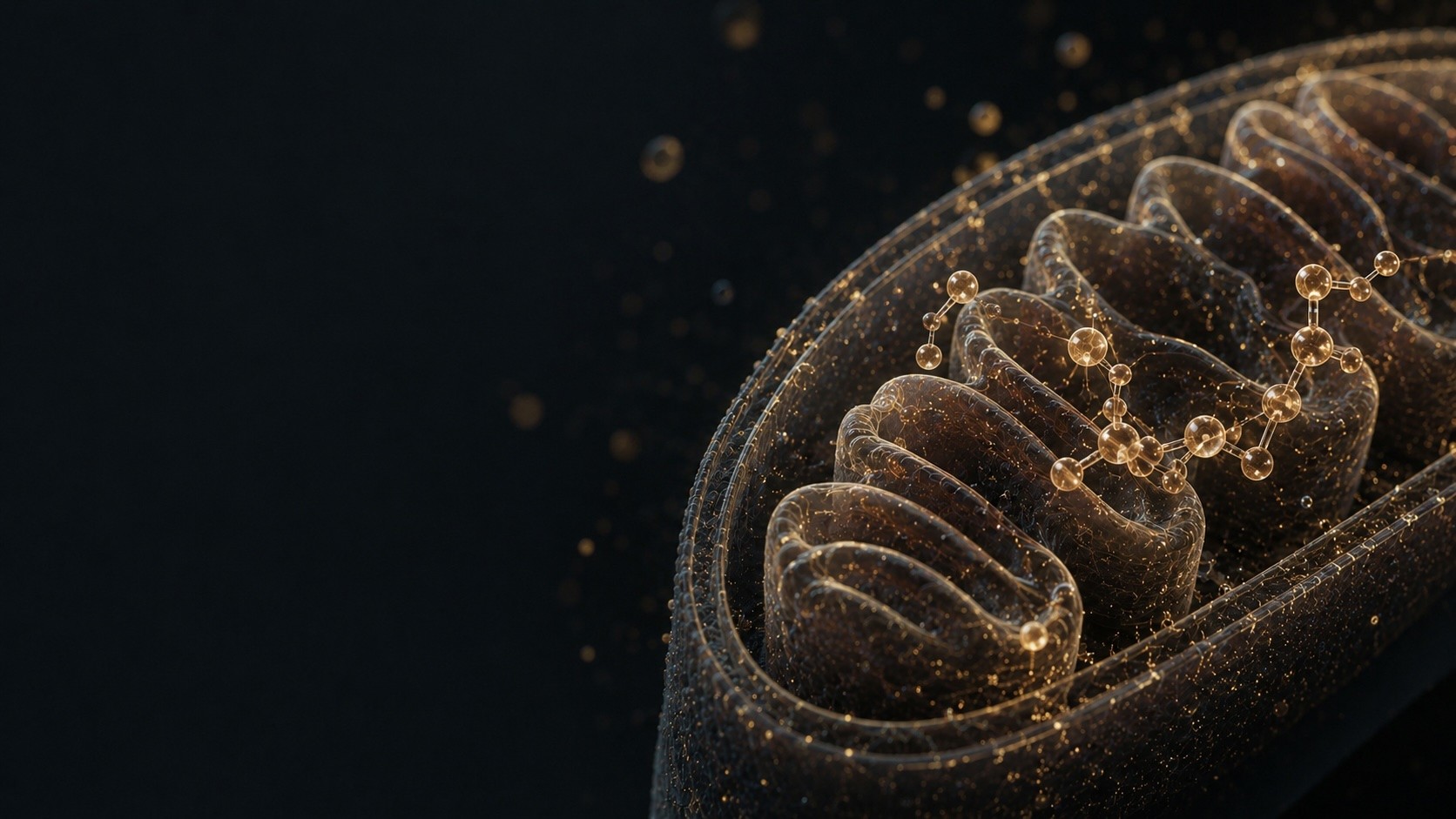
NAD+ and Coenzyme Q10 are two of the most studied molecules in the mitochondrial biology of aging. Their pairing in the scientific literature is not accidental — it reflects a precise biochemical reality: these two molecules operate at consecutive steps of the same fundamental cellular process.
Understanding their relationship means understanding how the mitochondrial respiratory chain actually works — and why its progressive decline after 40 has measurable consequences for energy, recovery, and overall cellular vitality.
The respiratory chain: a molecular assembly line
ATP production in mitochondria does not happen in a single step. It unfolds as a cascade of reactions organised across five protein complexes anchored in the inner mitochondrial membrane — what biochemists call the electron transport chain, or respiratory chain.
The underlying principle is electron transfer. Electron-rich molecules (NADH, FADH2) donate their electrons to a series of increasingly electronegative acceptors, releasing energy at each handoff — energy that drives the pumping of protons across the membrane and powers ATP synthesis at Complex V (ATP synthase).
This is the context in which NAD+ and CoQ10 play their complementary, sequential roles.
NAD+: the electron donor at Complex I
NAD+ (nicotinamide adenine dinucleotide) is the central coenzyme of cellular energy metabolism. In the respiratory chain, it is the reduced form — NADH — that acts directly.
NADH is the primary substrate of Complex I (NADH dehydrogenase), the first and largest complex of the respiratory chain. Complex I oxidises NADH back to NAD+ and transfers the two released electrons to CoQ10 — a reaction coupled to the pumping of four protons across the inner mitochondrial membrane, building the electrochemical gradient that drives ATP synthase.
NAD+ availability is therefore the essential upstream requirement for Complex I to function. Without sufficient NAD+ to be reduced to NADH by Krebs cycle enzymes, Complex I has no substrate — and the respiratory chain stalls before it begins.
Coenzyme Q10: the mobile electron carrier to Complex III
Coenzyme Q10 (ubiquinone in its oxidised form) is a fat-soluble molecule that diffuses freely within the lipid bilayer of the inner mitochondrial membrane. It is the only mobile electron carrier in the respiratory chain — a distinction that makes it irreplaceable.
CoQ10 draws electrons from two sources:
Complex I, which reduces it to ubiquinol (CoQ10H2) following NADH oxidation
Complex II (succinate dehydrogenase), which oxidises succinate to fumarate
It then shuttles those electrons to Complex III (cytochrome bc1), where they continue toward Complex IV and finally to molecular oxygen — the chain's terminal acceptor.
The relationship between NAD+ and CoQ10 is strictly sequential: NADH hands its electrons to Complex I, which immediately passes them to CoQ10. Without both, the chain is incomplete.
SIRT3: the molecular bridge between NAD+ and Complex I efficiency
The connection between NAD+ and CoQ10 goes beyond electron transfer. There is a third level — operating through the mitochondrial sirtuins.
SIRT3 is the primary mitochondrial sirtuin. Like all sirtuins, it depends on NAD+ for its deacetylase activity. Among its principal targets are several subunits of Complex I.
Research published in Cell Metabolism showed that SIRT3 deacetylates and activates key Complex I subunits — improving its catalytic efficiency and reducing the electron leaks that generate reactive oxygen species (ROS). Put simply: the more NAD+ is available, the more active SIRT3 becomes, the more efficiently Complex I runs, and the more effectively CoQ10 can fulfil its role as electron carrier.
This creates a three-step functional cascade: NAD+ → SIRT3 activation → Complex I optimisation → efficient CoQ10 utilisation → maximum ATP output.
Parallel decline: two trajectories that reinforce each other
One of the most important observations in the bioenergetics of aging is that both NAD+ and CoQ10 decline with age — and that the two declines are self-reinforcing.
NAD+ decline is well documented. Intracellular NAD+ levels fall progressively from the thirties onward, driven by increased consumption (through PARP and CD38 activity) and reduced endogenous biosynthesis. This drop blunts SIRT3 activity, undermines Complex I function, and generates more electron leaks — increasing mitochondrial oxidative stress.
CoQ10 follows a parallel trajectory. Studies have documented a progressive reduction in CoQ10 concentrations across human tissues with age. Research by Kalen et al. recorded a marked drop in CoQ10 levels in human cardiac muscle between the ages of 20 and 80. This decline reduces the electron-carrying capacity between Complexes I/II and III — creating a bottleneck in the respiratory chain.
The downstream consequences compound each other: less NAD+ impairs Complex I and reduces SIRT3 activation → less CoQ10 slows electron transfer to Complex III → the entire chain loses efficiency → ATP output falls → the most energy-demanding cells — neurons, cardiomyocytes, skeletal muscle — are the first to feel it.
This mechanism goes some way toward explaining why the fatigue, slower recovery, and metabolic deceleration that set in progressively after 40 are not isolated phenomena. They are signs of the same upstream collapse in cellular bioenergetics.
Evidence on NAD+ restoration and mitochondrial function
Johan Auwerx and his team at EPFL published landmark research showing that restoring NAD+ levels improves overall mitochondrial function in aging animal models. The effects run through SIRT3 activation and improved respiratory complex efficiency — including Complex I, the direct upstream partner of CoQ10.
These findings suggest that NAD+ restoration does more than supply the respiratory chain with electrons. It also improves the protein machinery that processes those electrons, creating conditions for more efficient use of available CoQ10.
Bioavailability: a shared challenge
Beyond their mechanistic relationship, NAD+ and CoQ10 share a common biological constraint: neither can be taken up directly by cells in its active form.
NAD+ is too large to cross cell membranes. It must be synthesised intracellularly from precursors such as nicotinamide riboside (NR) or nicotinamide mononucleotide (NMN), which rely on dedicated transporters (NRK1, NRK2) to enter cells.
CoQ10 must cross biological membranes and reach the lipid bilayer of the inner mitochondrial membrane. Its oral bioavailability is sensitive to formulation quality and shifts with age, alongside the enzymatic changes that accompany cellular aging.
Both constraints highlight the importance of formulation quality in any nutritional strategy targeting mitochondrial function — and why treating these two molecules as a complementary system, rather than standalone compounds, reflects the underlying biochemistry more accurately.
What cell biology establishes
The relationship between NAD+ and CoQ10 is not theoretical. It is a biochemical reality built into the architecture of the mitochondrial respiratory chain. These two molecules operate at consecutive steps of the same process, are both regulated by the same mitochondrial sirtuins, and both follow documented decline trajectories with age.
That convergence places mitochondrial biology — and the compounds that support it — at the centre of any rigorous scientific approach to longevity-oriented cellular nutrition.
The network, not the molecule
Cellular energy production is not a process that can be meaningfully supported by a single compound. It is a cascade in which each step depends on the one before it — and whose overall efficiency is determined by the availability of every component in the chain.
The mitochondrial biology of aging is not the story of a single molecule. It is the story of a network.
References: Auwerx et al., Cell Metabolism (2013) · Ahn et al., Cancer Cell (2008) · Kalen et al., Lipids (1989) · Trammell et al., Nature Communications (2016) · López-Otín et al., Cell (2023) · Bratic & Larsson, Journal of Clinical Investigation (2013)
This article is published for informational and educational purposes only. It does not constitute medical advice and is not a substitute for professional healthcare consultation.
NAD+ and Coenzyme Q10 operate at consecutive steps of the mitochondrial respiratory chain. Their parallel decline with age partly explains the cellular energy collapse observed after 40.
NAD+ and CoQ10: mechanistic complementarity in the mitochondrial respiratory chain. NADH, Complex I, SIRT3, mitochondrial biogenesis and age-related decline — the cell biology of two molecules that operate sequentially in ATP production.