What the World's Oldest Animals Teach Us About the Biology of Longevity
Longevity Science
10 min
Cell Reports · Nature · Science · PNAS · Nature Communications · PubMed
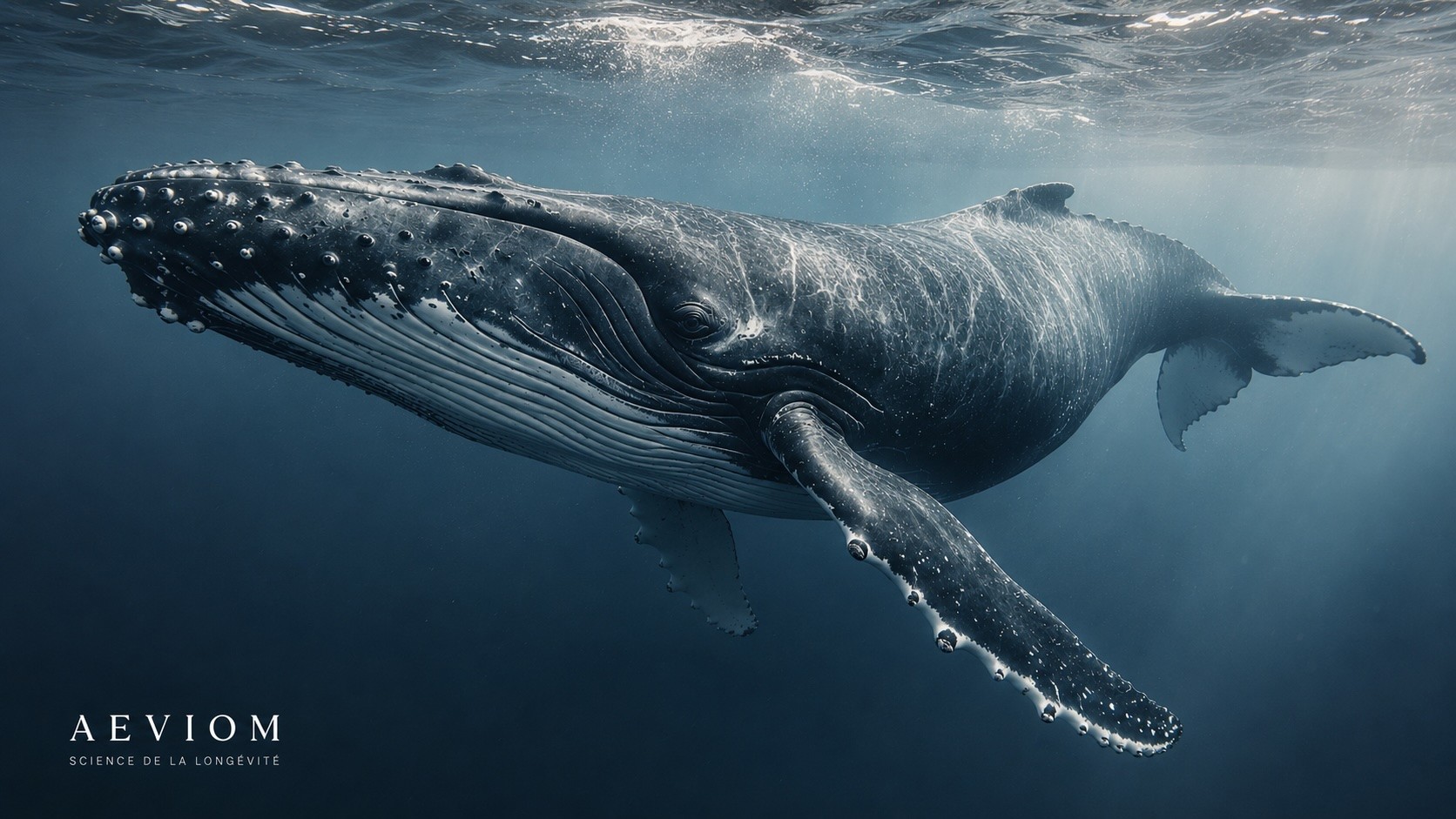
In Arctic waters, a whale has been swimming since before the French Revolution. In geroscience laboratories, a rodent the size of a mouse outlives its cousins tenfold without ever developing cancer. In mosses and lichens across the world, a microscopic animal survives the vacuum of space, lethal radiation, and temperatures approaching absolute zero.
Over hundreds of millions of years of evolution, nature has produced biological solutions to longevity that human science is still working to decode. These are not footnotes in zoology. They are natural experiments of extraordinary scientific value — living proof that the mechanisms of aging are not fixed physical laws, but variable biological parameters, shaped by evolution and open to modification.
The bowhead whale: 200 years of near-perfect DNA repair
The bowhead whale (Balaena mysticetus) is the longest-lived mammal on record. Specimens have been found carrying ivory harpoon tips from the nineteenth century embedded in their flesh. Maximum longevity estimates exceed 200 years — a lifespan five times that of humans for an organism of comparable size.
The bowhead genome was sequenced by Keane et al. (Cell Reports, 2015). Researchers identified several distinctive features:
Exceptional DNA repair capacity. Unique variants in the ERCC1 and PCNA genes are linked to significantly greater genomic damage repair efficiency than in short-lived mammals.
Enhanced cancer resistance. Genomic analysis reveals amplifications of tumour suppressor genes and unusually robust cell-cycle surveillance mechanisms.
Longevity-adapted metabolic regulation. Modifications in the IGF-1 and mTOR pathways suggest reduced growth signalling — consistent with what caloric restriction studies have established about longevity.
The naked mole rat: the mammal that refuses to age
The naked mole rat (Heterocephalus glaber) lives up to 37 years in captivity — roughly ten times longer than mice of comparable size. But exceptional longevity is only one of its remarkable traits.
Near-complete cancer resistance. The mechanism, identified by Vera Gorbunova at the University of Rochester, involves very high molecular weight hyaluronic acid (HMW-HA), which triggers an unusually strong contact inhibition of tumour growth.
Superior proteostasis. Naked mole rat cells maintain an exceptionally high standard of protein quality. The accumulation of misfolded proteins — a hallmark of normal aging — is significantly curtailed.
Negligible senescence. Rochelle Buffenstein published an analysis in eLife (2018) showing that the mortality rate of the naked mole rat does not rise with age. Its mortality curve does not follow Gompertz's law. It is one of the few mammals known to exhibit negligible senescence.
The Greenland shark: 400 years in the Arctic depths
Nielsen et al. (Science, 2016) estimated the age of a female specimen at approximately 392 years, with a maximum possible longevity exceeding 500. The Greenland shark is the longest-lived vertebrate currently known to science. Sexual maturity is not reached until around age 150.
The biology driving this longevity is still being characterised, but the shark's extreme cold habitat, exceptionally slow metabolism, and unusually low levels of oxidative damage are all consistent with the cellular mechanisms found in other long-lived species.
The immortal jellyfish: transdifferentiation as a biological reset
Turritopsis dohrnii is the only organism known to revert from its adult form back to a larval state — and to restart its developmental cycle indefinitely. This process of transdifferentiation amounts to a complete biological reset, an idea that maps directly onto current research into partial cellular reprogramming by David Sinclair and others working on epigenetic rejuvenation.
The hydra: biological immortality in fresh water
The hydra is composed of roughly 60% continuously dividing pluripotent stem cells, whose permanent renewal maintains tissue integrity without limit. The organism's entire body is replaced within a matter of weeks. Studies by Daniel Martinez found no measurable increase in mortality with age. Senescence, it turns out, is not a universal biological fate.
The tardigrade: surviving everything, including time
Tardigrades — commonly known as water bears — can withstand temperatures of -272°C and +150°C, pressures of 6,000 atmospheres, radiation doses lethal to humans, the vacuum of space, and decades of complete desiccation.
They achieve this through two mechanisms of particular scientific interest. First, they produce CAHS proteins (Cytoplasmic-Abundant Heat Soluble) that form a glass-like gel preserving cellular structures intact during extreme stress. Second, a gene called Dsup (Damage Suppressor) binds directly to chromatin and physically shields it from radiation damage — with no known equivalent in any other species (Hashimoto et al., Nature Communications, 2016).
The Arctic clam: 507 years of near-perfect proteostasis
Arctica islandica holds the documented animal longevity record. A specimen named "Ming" — born in 1499 — was dated at 507 years. These molluscs display remarkable resistance to oxidative stress and exceptional protein quality control, with antioxidant systems (superoxide dismutase, catalase, glutathione peroxidase) significantly more efficient than those of short-lived bivalves.
What these species tell geroscience
Taken together, these organisms establish a single foundational point: aging is not a fixed universal mechanism. It is a biological programme, shaped by evolutionary pressure — and its parameters vary across several orders of magnitude depending on the species.
The recurring mechanisms identified across these species converge directly with the Hallmarks of Aging framework:
Superior DNA repair (bowhead whale, tardigrade, Greenland shark) — bearing directly on genomic instability, the first primary Hallmark.
Exceptional proteostasis (naked mole rat, Arctic clam) — maintaining protein integrity against the passage of time.
Enhanced oxidative stress resistance (tardigrade, Arctic clam, Greenland shark) — limiting mitochondrial damage at its source.
Modulated growth signalling (bowhead whale, naked mole rat) — through downregulated IGF-1/mTOR pathways.
Active cellular renewal (hydra, immortal jellyfish) — exploring maintenance strategies that diverge fundamentally from the mammalian model.
The biological proof
The whale that swam before the French Revolution, the rat that resists cancer, the jellyfish that resets its own biology, the microscopic animal that survives outer space — these organisms are empirical evidence that aging is a modulable process, whose parameters evolution has already moved, in some cases, by orders of magnitude.
What nature has worked out over 500 million years of selection, the biology of aging is now trying to understand in a few decades of research.
References: Keane et al., Cell Reports (2015) · Nielsen et al., Science (2016) · Hashimoto et al., Nature Communications (2016) · Buffenstein, eLife (2018) · López-Otín et al., Cell (2023)
This article is published for informational and educational purposes only. It does not constitute medical advice and is not a substitute for professional healthcare consultation.
A whale swimming since before the French Revolution. A rat that never develops cancer. A microscopic animal that survives the vacuum of space. Nature has produced biological solutions to longevity that geroscience is deciphering today to extract universal principles.
Bowhead whale 200 years, naked mole rat, Greenland shark 400 years, tardigrade, immortal jellyfish Turritopsis dohrnii: what the most long-lived animals teach geroscience about the biological mechanisms of longevity.