5 Habits That Accelerate Biological Aging
Longevity Science
6 min
Nature · Cell · Nature Medicine · PubMed
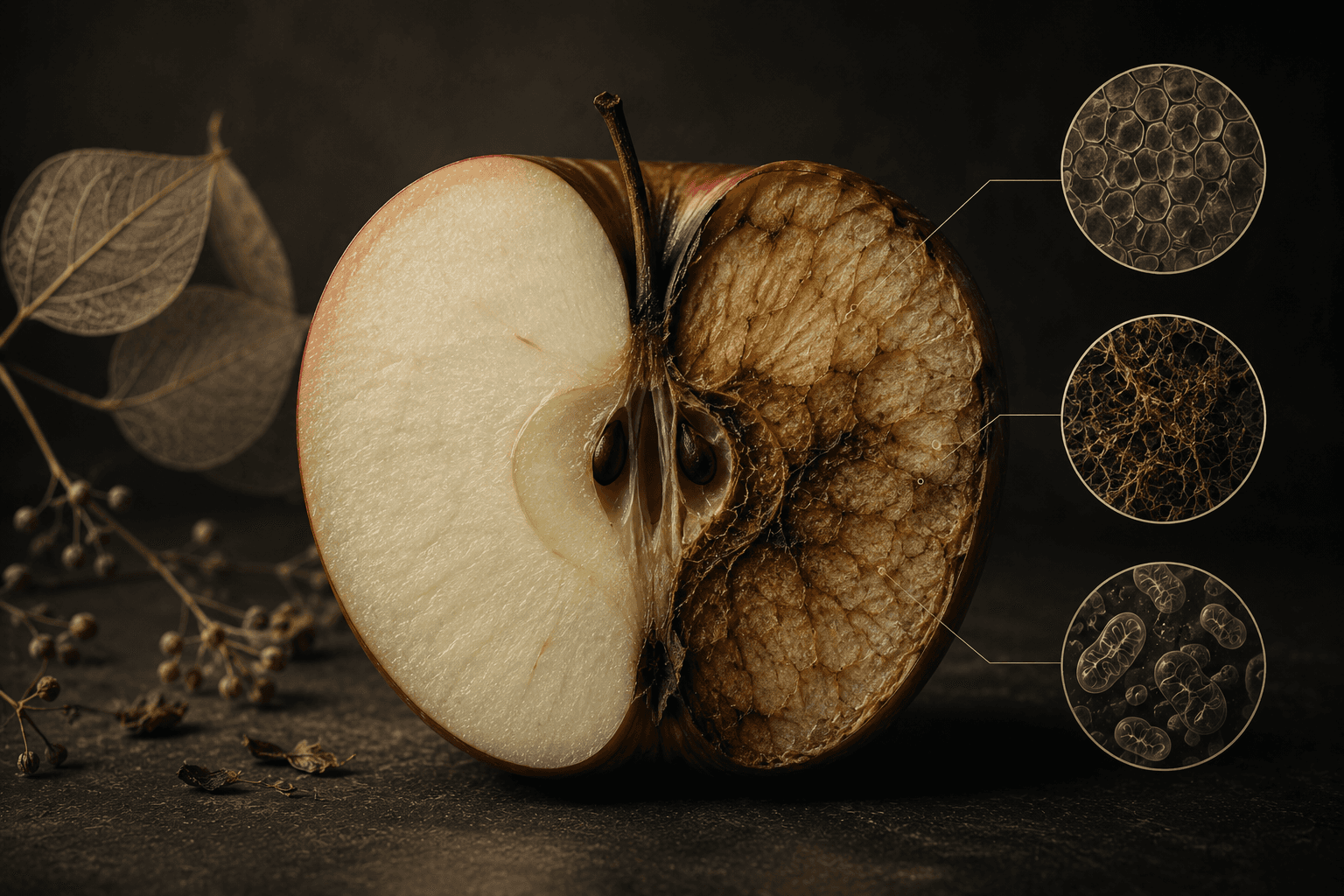
Biological aging is not a uniform fate. Two people of the same chronological age can show radically different biological profiles — shorter telomeres, a more advanced epigenetic clock, more pronounced mitochondrial dysfunction. Contemporary geroscience has identified the factors that account for these gaps.
Certain daily habits measurably accelerate the cellular mechanisms of aging. Not in some vague, abstract sense — in a documented, quantifiable way, visible in biological biomarkers. Here are the five most firmly established in the scientific literature.
1. Chronic sedentary behaviour
Sedentary behaviour is not simply the absence of exercise. It is an active — and damaging — biological state.
Sitting for more than eight hours a day is associated with a measurable acceleration of the epigenetic clock, faster telomere shortening, and a significant decline in skeletal muscle NAD+ levels. These effects are independent of time spent exercising: an hour of daily sport does not fully offset ten hours of sitting.
The primary mechanism: prolonged muscular inactivity reduces AMPK activation — the kinase that drives mitochondrial biogenesis, autophagy, and NAD+ utilisation. Without this regular stimulus, mitochondria age faster, cellular waste accumulates, and inflammaging progressively takes hold.
A meta-analysis published in the Annals of Internal Medicine found that the most sedentary individuals had a 49% higher all-cause mortality risk than those who regularly broke up their sitting time — even without engaging in structured sport.
2. Chronic sleep deprivation
Sleeping fewer than six hours a night chronically is not simply a matter of fatigue. It is a profound disruption of cellular biology.
During sleep, the brain's glymphatic system clears metabolic waste accumulated throughout the day — including amyloid-β, implicated in Alzheimer's disease. DNA repair runs at its peak. NAD+ levels are replenished in line with the circadian rhythm governed by BMAL1 and NAMPT. Memory consolidation occurs.
Chronic sleep deprivation disrupts all of these processes simultaneously. Studies have shown that a single week of insufficient sleep is enough to alter the expression of more than 700 genes involved in inflammation, immunity, and stress response. The epigenetic clock accelerates. Inflammaging markers rise.
A study published in Nature Communications found that a single night of total sleep deprivation significantly elevated blood tau levels — a protein biomarker of brain aging.
3. Unresolved chronic stress
Acute stress is biologically useful. Chronic stress, by contrast, is one of the most thoroughly documented accelerators of cellular aging.
Prolonged activation of the HPA axis (hypothalamic-pituitary-adrenal) keeps cortisol persistently elevated. That sustained cortisol load accelerates telomere attrition — the telomeres of individuals under intense chronic stress are measurably shorter than those of their peers. A landmark study by Elizabeth Blackburn and Elissa Epel on caregivers of chronically ill patients found a telomeric age acceleration equivalent to ten additional years of biological aging.
Chronic stress also activates NF-κB — the master regulator of inflammation — directly fuelling inflammaging. It blunts sirtuin activity through NAD+ depletion. It disrupts the gut microbiome via the gut-brain axis. And it undermines sleep quality, creating a compounding loop between stress, insomnia, and accelerated aging.
4. Ultra-processed food and refined sugars
Ultra-processed food — defined by the NOVA classification as industrially produced items containing additives, emulsifiers, colourings, and artificial flavourings — is linked in numerous epidemiological studies to an acceleration of biological aging. Several mechanisms are at work, and they converge.
The gut dysbiosis these foods generate depletes the microbiome of beneficial bacteria, increases intestinal permeability, and fuels systemic inflammaging as bacterial LPS leaks into circulation.
The chronic hyperglycaemia they drive permanently activates mTORC1 — the brake on autophagy — blocking cellular recycling and promoting the build-up of protein waste.
Protein glycation — the process by which glucose bonds to proteins to form AGEs (Advanced Glycation End-products) — progressively stiffens cell membranes, blood vessels, and connective tissue.
A study published in Cell Metabolism found that even moderate ultra-processed food consumption is associated with a measurable reduction in telomere length across large cohorts.
5. Chronic social isolation
Of all the premature mortality risk factors, social isolation may be the most underestimated by the general public — and one of the most thoroughly documented in the scientific record.
A meta-analysis by Holt-Lunstad et al. published in PLOS Medicine drew on data from 148 studies covering more than 300,000 individuals and found that social isolation raises mortality risk by 29% — an effect comparable to smoking 15 cigarettes a day.
The biological mechanisms are well characterised: chronic isolation activates threat-signalling pathways in the hypothalamus, elevates baseline cortisol, upregulates the expression of pro-inflammatory genes (particularly via NF-κB), accelerates telomere attrition, and disrupts sleep quality.
It is no coincidence that every Blue Zone — Okinawa, Sardinia, Ikaria, Nicoya, Loma Linda — shares a defining characteristic: strong social cohesion, deep community ties, and a sense of belonging maintained into very advanced age.
What geroscience establishes
These five habits do not accelerate aging in some vague or diffuse way. They engage specific biological mechanisms — measurable in biomarkers, visible in epigenetic clocks, documented across cohorts of tens of thousands of individuals.
The important point: unlike genetics, these factors are modifiable. Twin studies consistently estimate the genetic contribution to biological longevity at 20 to 30%. The remaining 70 to 80% is shaped by environment, lifestyle, and daily habits.
Accelerated biological aging is not inevitable. It is, in large part, the result of what we do — or fail to do — every day.
References: Holt-Lunstad et al., PLOS Medicine (2010) · Blackburn & Epel, PNAS (2004) · Biswas et al., Annals of Internal Medicine (2015) · Sonnenburg & Bäckhed, Nature (2016) · López-Otín et al., Cell (2023)
This article is published for informational and educational purposes only. It does not constitute medical advice and is not a substitute for professional healthcare consultation.
Biological aging is not just a matter of genetics. Certain daily habits measurably accelerate the cellular mechanisms of aging — and contemporary geroscience has identified the precise molecular mechanisms behind each of them.
5 habits that accelerate biological aging: sedentary lifestyle, sleep deprivation, chronic stress, ultra-processed food and social isolation. The cellular mechanisms documented by contemporary geroscience.