Circadian Clock and Aging : Why Your Biological Rhythm Conditions Your Longevity
Longevity Science
7 min
Science · Cell Metabolism · Nature Reviews Neuroscience · Nobel Prize 2017 · PubMed
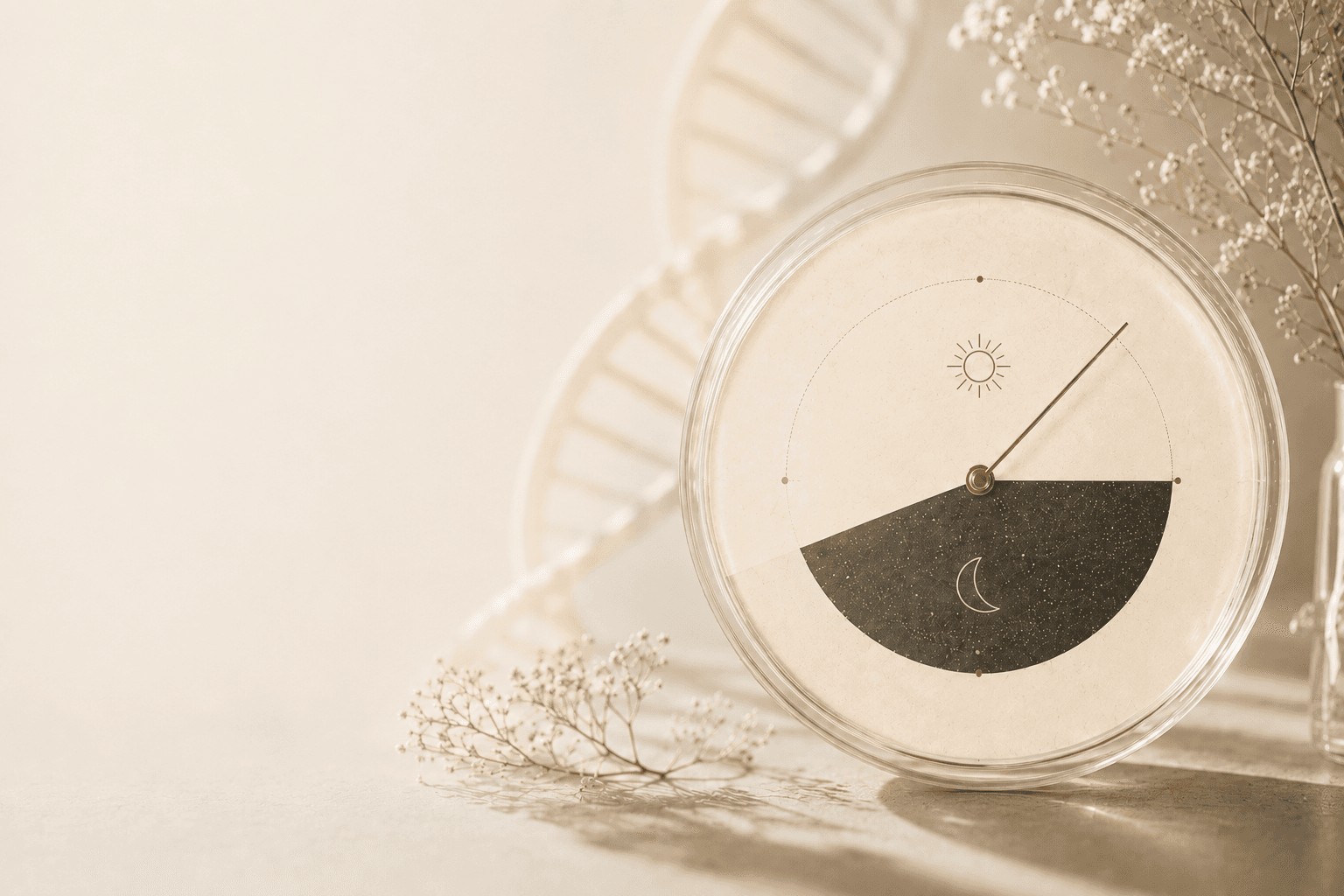
In 2017, the Nobel Prize in Physiology or Medicine went to Jeffrey Hall, Michael Rosbash, and Michael Young for their work on the molecular mechanisms of the circadian clock. Coming just two years after Yoshinori Ohsumi's Nobel for autophagy, it was once again a fundamental cellular process — this time one governing biological time itself — that received the scientific community's highest recognition.
The detail worth pausing on is this: the circadian clock is not a metaphor. It is not the vague sense that you feel more alert in the morning or crave sleep at night. It is a precise molecular mechanism encoded in virtually every cell in the human body — and its progressive breakdown with age is now recognised as a hallmark of aging in its own right, with measurable consequences for sleep architecture, metabolic regulation, immune function, DNA repair, and longevity.
Here is what that actually means.
A clock in every cell
The central finding of the 2017 Nobel work — built on decades of research in fruit flies and later confirmed in mammals — is that circadian rhythms are not simply a response to environmental cues like light and darkness. They are generated autonomously, inside individual cells, by a self-sustaining molecular feedback loop.
The core mechanism involves a small number of proteins. CLOCK and BMAL1 form a heterodimer that drives the transcription of two families of genes: the Period genes (PER1, PER2, PER3) and the Cryptochrome genes (CRY1, CRY2). The proteins produced — PER and CRY — gradually accumulate, form a complex, and re-enter the nucleus where they suppress the activity of CLOCK/BMAL1, shutting down their own production. As PER and CRY levels fall, CLOCK/BMAL1 activity resumes, and the cycle begins again.
This negative feedback loop generates an oscillation of almost exactly 24 hours. Its precision is remarkable: it runs autonomously in each cell, without requiring external input to sustain it.
A secondary feedback loop involving Rev-erbα and RORα adds further stability and fine-tunes the amplitude of the oscillation, reinforcing the system's robustness against perturbation.
The master pacemaker — the suprachiasmatic nucleus (SCN) of the hypothalamus, a cluster of roughly 20,000 neurons — synchronises the peripheral clocks in all tissues through hormonal signals (primarily cortisol and melatonin) and the autonomic nervous system. But every organ — liver, muscle, heart, gut — runs its own local clock, tuned to the central signal but operating with considerable autonomy.
The scale of circadian regulation across the genome is striking. Studies in mice and humans suggest that somewhere between 40 and 80% of all protein-coding genes show circadian oscillation in at least one tissue. The biological clock does not regulate a handful of processes at the margins. It coordinates the temporal architecture of essentially every major cellular function.
What aging does to the clock
The disruption of circadian function with age is one of the most consistent findings in geroscience — and one of the most consequential.
Oscillation amplitude falls. In older individuals, the daily variation in circadian hormones, core body temperature, and physiological parameters is measurably flattened. The biological signal becomes less precise, less robust, and less synchronised across tissues. This dampening of circadian amplitude is among the most reliable biomarkers of biological aging available.
Light sensitivity declines. The capacity of light to reset the central clock degrades with age, partly because of reduced sensitivity in the melanopsin-containing retinal ganglion cells responsible for transmitting light information to the SCN. Older adults require higher light intensities and longer exposures to achieve equivalent clock entrainment compared to younger adults.
Clock gene expression shifts. Transcriptomic studies reveal altered expression patterns in BMAL1, PER2, and CRY1 across multiple tissues — disrupting the molecular precision of oscillation in ways that ripple through downstream regulated processes.
The mitochondrial clock is compromised. Mitochondria maintain their own circadian rhythmicity, with oscillating patterns of oxidative phosphorylation and ATP production tied to the 24-hour cycle. Age-related mitochondrial dysfunction disrupts this rhythmicity, creating a desynchronisation between cellular energy metabolism and the timing signals that should coordinate it.
The practical consequence of these changes is not simply that older people sleep less well — though they do. It is that the temporal coordination of cellular biology progressively breaks down. Processes that depend on being active at precise times of day — DNA repair, immune surveillance, metabolic clearance — lose their timing precision simultaneously.
The NAD+, sirtuins, and clock: a three-way molecular relationship
Perhaps the most important finding for understanding the intersection of circadian biology and aging is the deep molecular coupling between the clock, NAD+ metabolism, and the sirtuins.
BMAL1 directly regulates the rhythmic expression of NAMPT — the rate-limiting enzyme in the NAD+ salvage biosynthesis pathway. As a result, intracellular NAD+ levels oscillate on a 24-hour cycle, peaking during active hours and falling during sleep. This was established in landmark research by Nakahata and colleagues and independently by Ramsey et al., both published in Cell in 2009.
SIRT1 sits at the centre of this loop. It is both regulated by NAD+ — requiring it as a substrate for its deacetylase activity — and a direct regulator of the clock itself. SIRT1 deacetylates BMAL1 and PER2, modulating the period and amplitude of circadian oscillation. More NAD+ means more SIRT1 activity, which means a better-tuned clock. Declining NAD+ with age means a progressively imprecise one [Bass & Lazar, Science, 2016].
SIRT3, the primary mitochondrial sirtuin, closes the loop by regulating mitochondrial metabolism in a circadian pattern. Its oscillating activity coordinates the timing of oxidative phosphorylation and ATP synthesis across the 24-hour cycle.
The implication is direct: the age-related decline in NAD+ does not only impair cellular energy production. It degrades the molecular precision of the biological clock itself — disrupting the timing of every process the clock coordinates, from DNA repair to immune function.
This three-way relationship between NAD+, the sirtuins, and the circadian clock has become one of the most studied axes in contemporary longevity research. It also explains, mechanistically, why the cellular consequences of aging rarely appear in isolation. The systems are too deeply coupled for that.
What circadian disruption does to cellular aging
Sleep architecture deteriorates. Deep slow-wave sleep — the phase during which the brain's glymphatic system clears metabolic waste, including amyloid-β implicated in Alzheimer's disease — is progressively lost with age. It is also during this phase that DNA repair runs at its highest rate and that NAD+ levels are replenished. Circadian disruption accelerates this process by undermining the hormonal signals that govern sleep architecture.
Glucose metabolism becomes dysregulated. The circadian clock controls insulin sensitivity, glucagon secretion, and hepatic glucose handling. Its disruption contributes directly to the progressive deterioration of glycaemic control with age — a finding with significant implications given the role of chronic hyperglycaemia in mTOR activation, AGE formation, and accelerated biological aging.
Immune precision is lost. Cytokine production, natural killer cell activity, and antibody responses all vary significantly by time of day — an expression of the immune system's deep circadian wiring. Circadian disruption contributes to immunosenescence and the chronic low-grade inflammation that characterises aging tissue [Asher & Schibler, Cell Metabolism, 2011].
DNA repair is compromised. The expression of DNA repair genes — including those governing nucleotide excision repair and double-strand break resolution — oscillates under circadian control. Disruption of the clock therefore undermines one of the cell's primary defences against genomic instability, the first primary Hallmark of Aging.
The epidemiological evidence reinforces the mechanistic picture. Shift workers — whose circadian clocks are chronically misaligned with their social and light environment — show elevated rates of metabolic syndrome, cardiovascular disease, several cancers, and cognitive decline. Circadian disruption from occupational night work is classified as a probable human carcinogen by the International Agency for Research on Cancer (IARC Group 2A). That classification is based on the same mechanistic evidence described above, applied across populations of millions.
Social jetlag: the chronic disruption most people don't recognise
Shift work is an extreme case. But there is a subtler, far more widespread form of circadian disruption that affects an estimated 70% of the working population: what chronobiologists call social jetlag.
Social jetlag is the mismatch between biological clock timing and social schedule timing — the gap between when your body wants to sleep and wake, and when your alarm clock compels you to. For a population with a late chronotype forced into early working hours, this can represent a daily misalignment of two to three hours — equivalent, in its biological consequences, to weekly transatlantic travel without the return journey.
Research by Till Roenneberg at Ludwig Maximilian University has shown that social jetlag is independently associated with higher BMI, elevated inflammatory markers, and impaired metabolic regulation — regardless of total sleep duration. The problem is not just how much sleep people get. It is whether they are sleeping when their biology is prepared for it.
Chrono-nutrition: when you eat is not secondary
One of the more counterintuitive findings in circadian biology is the extent to which the timing of food intake shapes its metabolic consequences — independently of what is eaten.
The liver, pancreas, and gut each maintain local circadian clocks that regulate digestive enzyme activity, insulin secretion, and nutrient absorption. These clocks are entrained not only by light, but by meal timing. Studies have consistently shown that the same meal consumed in the morning versus the evening produces measurably different glycaemic, lipid, and hormonal responses — because the metabolic machinery processing it is in a different phase of its daily cycle.
The practical implication is not trivial. Eating late at night, when hepatic glucose metabolism is suppressed and insulin sensitivity is at its daily nadir, produces a metabolic stress the same calories consumed at midday would not.
This temporal dimension of nutrition extends to supplementation. The circadian regulation of NAMPT — which governs the rate of NAD+ biosynthesis — suggests that the timing of NAD+ precursor intake is not biologically irrelevant. The cellular machinery responsible for converting those precursors into active NAD+ operates on a 24-hour schedule. When that schedule is respected, the biochemical environment for conversion and utilisation is more favourable.
What geroscience has established
The biological clock is a central coordination system for virtually every major cellular process — from energy metabolism to DNA repair, immune surveillance to epigenetic maintenance.
Its coupling to NAD+ and the sirtuins means that its progressive deterioration with age is not an isolated phenomenon. It is woven into the same molecular network that governs mitochondrial function, telomere maintenance, and the cellular response to stress.
The 2017 Nobel did not simply recognise an elegant piece of molecular biology. It recognised that time — biological time, cellular time — is an active parameter of health. Not the passage of years, but the precision with which cells know what hour it is, and organise their activity accordingly.
When that precision degrades, aging accelerates across multiple systems simultaneously. When it is supported, it creates the temporal conditions in which the cell's own maintenance programmes can run at full efficiency.
The biology of aging has learned one thing clearly: time is not merely what passes while we age. It is a molecular variable — and it is one that can be influenced.
References: Bass & Lazar, Science (2016) · Nakahata et al., Cell (2009) · Ramsey et al., Cell (2009) · Asher & Schibler, Cell Metabolism (2011) · Roenneberg et al., Current Biology (2012) · López-Otín et al., Cell (2023)
This article is published for informational and educational purposes only. It does not constitute medical advice and is not a substitute for professional healthcare consultation.
In 2017, the Nobel Prize in Physiology was awarded to the discoverers of the molecular mechanisms of the circadian clock. Its progressive disruption with age affects sleep, metabolism, immunity and longevity — through a direct link with NAD+ and sirtuins.
Circadian clock and aging: how the disruption of biological rhythm after 40 affects NAD+, sirtuins SIRT1/SIRT3, sleep and cellular longevity. Nobel 2017, BMAL1, CLOCK and chronobiology explained by geroscience.